Pages

Donnerstag, 28. November 2013

Magnhild Fossum


Magnhild Fossum
Norwegian dancer, choreographer and video artist.
http://www.magnhildfossum.no


The Posthuman Manifesto


The production and appreciation of Art is a particularly Human faculty. It is often cited by the Humanists as the highest expression of Human thought and the thing which most distingushes us from machines. It would, therefore, be fair to admit that the Post_Human era cannnot begin in full until we have met this challenge from the Humanists. In order to develop a machine which can produce and appreciate Art we must first have a clearer understanding of what it is. http://www.robertpepperell.com/Posthum/art.htm


Transhumanism

Transhumanismus (zusammengesetzt aus lat. trans ‚jenseits, über, hinaus‘ und humanus ‚menschlich‘) ist eine philosophische Denkrichtung, die die Grenzen menschlicher Möglichkeiten durch den Einsatz technologischer Verfahren erweitern will. Die Interessen und Werte der Menschheit werden als "Verpflichtung zum Fortschritt" angesehen.
http://de.wikipedia.org/wiki/Transhumanismus


Energy Bank
http://www.energy-bank.org/

Energy Bank. User Manual (jp/eng) from Amanda Steggell on Vimeo.


Everybodys Toolbox
Everybodys is a data base and a library, a toolbox and a game creator, a publication house, a score container, a site for distribution and for long term investigatory discussions. It is a platform for the development of tools and content, for research and performance, for exchange and desire.
Everybodys is a collective effort to develop the discourses that exist within the performing arts and to create a platform where this information can be accessed by a wider audience than the practitioners it involves.
-> 10 statements (or How To)
http://www.everybodystoolbox.net/?q=node/126


Kein Leuchtturm, sondern ein Raum unter vielen


Kulturförderung


Die aktuelle Kulturförderung mag klar definierte Projekte, die zu «Leuchttürmen» erklärt werden können. Doch was geschieht mit selbstorganisierten Räumen, bei denen nicht von Anfang an klar ist, was sich wann daraus ergeben wird? 

Freitag, 22. November 2013

Robert E. Park - The City

Robert E. Park, The City, 1925


"In „The city“ schlägt Park ein Programm zur Untersuchung menschlichen Verhaltens in der Großstadt vor. Dieser Aufsatz ist ein Grundstein für die empirische Soziologie, in dem Park in vier Abschnitten sein Untersuchungsfeld die Großstadt behandelt:

1. Abschnitt: Untersuchung der Wechselwirkung zwischen physischer Struktur und kultureller Ordnung der Stadt.

2. Abschnitt: Individualisierung und Spezialisierung in der Großstadt und die daraus resultierenden Folgen werden thematisiert

3. Abschnitt: Behandlung der Veränderung in Beziehungen und Gewohnheiten der Stadtbewohner

4. Abschnitt: Park befasst sich mit dem charakteristischen Großstädtischen und dem „Naturell“ der Großstadtbürger


In seiner Gesellschaftstheorie unterscheidet Park zwei Ordnungen. Der gesellschaftliche Unterbau ist für ihn das Subsystem, die „community“, auf dem sich die gesellschaftliche Ordnung entwickelt, der eigentliche Untersuchungsgegenstand der Soziologie.
Der gesellschaftliche Reproduktionsverlauf wird nach Park durch Kommunikation und Konkurrenz geschaffen und aufrechterhalten. Die Konkurrenz bewirkt Individualisierung, die Kommunikation Integrierung und Vergesellschaftung. Die Kommunikation als Kulturideal kann nur mit selbstbewussten, verschiedenen Individuen funktionieren.
Zusammenfassend beschäftigte sich Park mit folgenden Themen: Vergesellschaftung, sozialer Wandel, Gruppenverhalten, Kommunikation, Stadt als Siedlungsstruktur, Bevölkerungsbewegung, soziale Mobilität, Rassenbeziehungen, Stadtentwicklung, Gruppenbildung, Kulturen und Subkulturen."

Quelle: http://de.wikibooks.org/wiki/Soziologische_Klassiker/_Park,_Robert_Ezra 

Robert E. Park, The American Journal of Sociology:
The City: Suggestions for the Investigation of Human Behavior in the City Environment


Parks Bedeutung liegt vor allem in der Prägung des Sociology Department an der University of Chicago, das nicht zuletzt durch ihn zum Zentrum der Chicagoer Schule für Soziologie wurde. Die Schule war u.a. von Weber und Simmel inspiriert und vollbrachte Pionierarbeit in der Mikrosoziologie, in der Stadtsoziologie und in Minderheiten- und Armutsstudien. Parks eigener Beitrag bestand vor allem in Studien städtischer Subkulturen und ethnischer Minderheiten. Er befasste sich auch mit methodologischen Fragestellungen, die für diese Themen relevant waren. Park formulierte die so genannte Melting-Pot-Theorie multiethnischer Integration, die auf seinen Erfahrungen des ethnischen Mosaiks in Chicago basierte.
Quelle: http://de.wikipedia.org/wiki/Robert_Ezra_Park


Sound of the city

Bobo Djoulasso, City Sounds, Simon Grab 2006


Tony Schwartz
Sound of the city
Ethnographic recordings
the world in my worldbox

Harry Smith
Folksways
Social Music Work songs


Sim cards from northern Mali
http://norient.com/podcasts/sim-cards-from-northern-mali/

Sound Ethnography Project
http://norient.com/podcasts/sound-ethnography-project/

John Cage Roaratorio
http://www.themodernword.com/joyce/music/cage_roaratorio.html
http://www.youtube.com/watch?v=C_UlIB6bti8


Luigi Russolo "Veglio Di Una Città"
http://www.youtube.com/watch?v=VHLmitA3o6g


Soundmapping
http://aporee.org/


Donnerstag, 21. November 2013

Selbstbildungsprozess

Saskia Holmkvist, 2005

The Stockholm based artist Saskia Holmkvist shows how repetition can influence an interview situation with her film Interview with Saskia Holmkvist (2005, 8:40 min.).
Film still, Saskia Holmkvist, Interview with Saskia Holmkvist (2005)


"mental comma instead of the full-stop"

Diskurse der kuratorischen Praxis

Work to do! Selbstorganisation in prekären Arbeitsbedingungen

3. Thematische Projektreihe, Shedhalle, Zürich 2007-2009
Konzept und Text: Sønke Gau und Katharina Schlieben
Kuratorische Assistenz: Iris Ströbel

Konzept 

Bild: www.it-agile.de - Experten für agile Softwareentwicklung


Folke Köbberling und Martin Kaltwasser - BAUSTOFFZENTRUM
eine Sammlung Zürcher Ressourcen, gesichtet und gesichert von Folke Köbberling und Martin Kaltwasser, für einen innerstädtischen Satelliten der Shedhalle. (2007. www.shedhalle.ch)


 Saskia Holmkvist - Internship in Private
"An vielen Arbeitsstätten greift man heutzutage auf die Arbeitskraft gut ausgebildeter unbezahlter PraktikantInnen zurück. Wenn qualifiziertes Personal unentgeltlich arbeitet, hat das Auswirkungen auf die Balance der Rollenverteilung und es entsteht ein schlechtes Gewissen, das auf verschiedene Weise kompensiert wird. Der ZEIT-Artikel Generation Praktikum (2005), in dem Matthias Stolz von seinen eigenen Erfahrungen als Praktikant berichtete, gab den Anstoss zur Diskussion über die heutigen prekären Arbeitsbedingungen für PraktikantInnen mit Hochschulabschluss. In meinen Nachforschungen, die ihren Ausgang in der Diskussion der ‹Generation Praktikum› nahmen, interessiert mich, welche Auswirkungen diese Arbeitsbedingungen sowohl für PraktikantInnen als auch für Angestellte und ArbeitgeberInnen auf privater Ebene haben." (www.shedhalle.ch)


Andreja Kuluncic  - 1 SFR = 1 STIMME
Politische Kunstintervention (September 2007 - März 2008)
"Die Aktion möchte ein Instrument für illegalisierte Personen in der Schweiz zur Verfügung stellen, mit dem sie auf politischer und öffentlicher Ebene Sichtbarkeit erlangen können. Sans-Papiers werden aufgefor dert einen Franken an das Parlament für die Renovierung des Schweizer Bundeshaus, welches derzeit renoviert wird, über das Konto von S-PAZ (Sans-Papiers Anlaufstelle Zürich) zu spenden. Das Parlament ist die öffentliche Stimme des Landes. Indem sie sich an dieses wenden, richten sie ihre Anliegen auch an die Schweizer Gesellschaft. Durch die Spende an die Gesellschaft übermitteln die Sans-Papiers die Nachricht, dass sie Verpflichtungen erfüllen möchten, aber auch an den Privilegien der Schweizer Gesellschaft, in der sie leben und arbeiten, teilhaben möchten."(www.shedhalle.ch)

Montag, 18. November 2013

Fourier Transform


Bild: Screenshot aus"What is k-space"


Gedankenstütze für weitere Fragestellungen im Bereich Fourier Transform / MRI:


Kommentar in http://nautil.us/blog/the-math-trick-behind-mp3s-jpegs-and-homer-simpsons-face:
"The idea behind the Fourier Transform is that you can express any periodic wave by summing loads of sines with different frequencies. In other words, that you can decompose any wave in a bunch of sines with different frequencies. Of course, when you hear this kind of thing, you should ask two questions:

1- Is it really possible to decompose any periodic wave in sines?
2- Is there an unique decomposition?

Sonntag, 17. November 2013

Transdisziplinäre Instrumente - Haircutter


"Haircut Nr. 2"
Performance by Simon Grab, 2008
SO21 Experimental Radio Broadcast, Radio Lora Zurich
@ Kunstraum Walcheturm, Zurich Switzerland

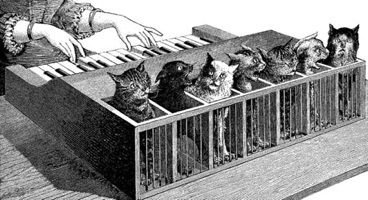
Transdisziplinäre Instrumente - Katzenklavier

"Der Zweck des Instruments war laut einer Beschreibung von Johann Christian Reil (1759-1813) die Behandlung von Patienten, denen es schwerfällt, sich zu konzentrieren. Reil glaubte, dass die Aufmerksamkeit eines Patienten, der dazu gezwungen wird das Katzenklavier zu sehen und zu hören, zwangsläufig auf das Instrument gerichtet wird und er somit geheilt ist (Richards, 1998)."
http://de.wikipedia.org/wiki/Katzenklavier


Wolfgang Welsch - "Transculturality – the Puzzling Form of Cultures Today"

In his text “Transculturality – the Puzzling Form of Cultures Today” Wolfgang Welsch explains in a few words Wittgensteins concept of culture:
“Philosophically, the one person who provides the greatest help for a transcultural concept of culture, however, is Wittgenstein. He outlined an on-principle pragmatically-based concept of culture, which is free of ethnic consolidation and unreasonable demands for homogeneity. According to Wittgenstein, culture is at hand wherever practices in life are shared. The basic task is not to be conceived of as an understanding of foreign cultures, but as an interaction with foreignness. [...] Culture in Wittgenstein’s sense is, by its very structure, open to new connexions and to further feats of integration. To this extent, a cultural concept reformulated along Wittgenstein’s lines seems to me to be particularly apt to today’s conditions.”
http://www2.uni-jena.de/welsch/Papers/transcultSociety.html
“I take this to be very important. Basically I think it is evident – yet it tends to be overlooked incurrent reflection. For in modernity we got used to thinking that everything is strictly bound toits cultural context. We take all experience and cognition to be strictly determined by their cultural framework and hence restricted to it. This is the typically modern axiom – or dogma – behind the contemporary relativism, contextualism and culturalism dominant in the humanities and in cultural studies today. But with this axiom we are blinding ourselves theoretically to the obviously non culture-bound, but transcultural potential of outstanding works or conceptions.”
 
Sources:
“Transculturality – the Puzzling Form of Cultures Today” Wolfgang Welsch
From: Spaces of Culture: City, Nation, World, ed. by Mike Featherstone and Scott Lash, London: Sage 1999, 194-213.
Wolfgang Welsch, Rethinking identity in the age of globalization – a transcultural perspective
Aesthetics & Art Science, ed. Taiwan Association of Aesthetics and Art Science, No. 1 (2002), 85-94.


Transculturality - the Puzzling Form of Cultures Today

"[...] a concept of culture which, I think, is appropriate to most cultures today: the concept of transculturality. I will contrast it with three other concepts: first with the classical concept of single cultures and then with the more recent concepts of interculturality and multiculturality. I believe the concept of transculturality to be the most adequate concept of culture today - for both descriptive and normative reasons.
[...]
Philosophically, the one person who provides the greatest help for a transcultural concept of culture, however, is Wittgenstein. He outlined an on-principle pragmatically-based concept of culture, which is free of ethnic consolidation and unreasonable demands for homogeneity. According to Wittgenstein, culture is at hand wherever practices in life are shared. The basic task is not to be conceived of as an understanding of foreign cultures, but as an interaction with foreignness. [...] Culture in Wittgenstein's sense is, by its very structure, open to new connexions and to further feats of integration. To this extent, a cultural concept reformulated along Wittgenstein's lines seems to me to be particularly apt to today's conditions."

From: Spaces of Culture: City, Nation, World, ed. by Mike Featherstone and Scott Lash, London: Sage 1999, 194-213.


Rethinking identity in the age of globalization - a transcultural perspective

"It's a truism to say that we are living in an age of globalization. It's a truism of almost the same degree to state that one of the most urgent problems posed by globalization is the problem of identity - of personal as well as cultural identity.
I want to address the question of identity in the first part of my paper, linking it with my conception of transculturality. [...]"
From: Aesthetics & Art Science, ed. Taiwan Association of Aesthetics and Art Science, No. 1 (2002), 85-94. 


Wolfgang Welsch -> Wikipedia