aus: http://de.wikipedia.org/wiki/W3C_Geolocation_API
Obwohl die Implementation nicht genauer beschrieben ist, baut die W3C Geolocation-API auf bereits existierenden Technologien auf und wurde stark von der Geolocation API von Google Gears beeinflusst. Tatsächlich verwendet die Implementation der Geolokation von Firefox[5] Googles Netzwerkpositionsanbieter.[6]
Google Gears Geolocation funktioniert, indem eine Reihe von Parametern, die einen Hinweis auf die aktuelle Ortsposition geben könnten, zu einem Network Location Provider Server (etwa: Netzwerkortsanbieter-Server) gesendet werden, welcher standardmäßig der von Google bereitgestellte ist. (code.l.google.com).[7] Einige dieser Parameter sind eine Liste von Handy-Funktürmen und deren Signalstärke, sowie eine Liste der ermittelten WLANs und deren Signalstärke. Diese Parameter werden in eine JSON-Nachricht eingebettet und an den Network Location Provider Server per HTTP-POST-Methode verschickt. Basierend auf diesen Parametern kann der Network Location Provider ihre Position erschließen.
Posts mit dem Label Soundmapping werden angezeigt. Alle Posts anzeigen
Posts mit dem Label Soundmapping werden angezeigt. Alle Posts anzeigen
Mittwoch, 26. Februar 2014
SOUNDMAPPING: Critiques And Reflections On This New Publicly Engaging Medium
Abstract
Soundmaps have captured the imagination of acoustic communities, libraries and radio stations alike. These interactive maps have placed soundscape collections and research in a more public and interactive space than ever before. However, does this new form reflect some of the polarizations of past sound projects or are there new fractures to be considered, such as gender, economy and the domestic/public divide? This paper will reflect upon the challenges and hierarchies that have developed alongside this new medium and will begin to critique and question this new form of sound engagement.
Source: http://journal.sonicstudies.org/vol01/nr01/a08
Soundmaps have captured the imagination of acoustic communities, libraries and radio stations alike. These interactive maps have placed soundscape collections and research in a more public and interactive space than ever before. However, does this new form reflect some of the polarizations of past sound projects or are there new fractures to be considered, such as gender, economy and the domestic/public divide? This paper will reflect upon the challenges and hierarchies that have developed alongside this new medium and will begin to critique and question this new form of sound engagement.
Source: http://journal.sonicstudies.org/vol01/nr01/a08

Dienstag, 25. Februar 2014
Auditory Architecture Research Unit (AARU), UDK Berlin
http://www.udk-berlin.de/sites/auditive-architektur/content/index_ger.html
Auditive Architektur ist eine künstlerisch-wissenschaftliche Disziplin, die sich mit der Erforschung und dem Entwerfen von Klangumwelten befasst. Die Auditory Architecture Research Unit (AARU) wurde gegründet, um den auditiv erlebten Raum für die architektonische Entwurfspraxis zu erschließen und als ein, in diese Praxis integriertes Gestaltungsfeld zu etablieren. Diese Zielsetzung begründet sich in der Tatsache, dass das Auditive unumgänglich konstitutiver Bestandteil erfahrener Architektur ist, jedoch im architektonischen Entwerfen bisher nicht systematisch berücksichtigt wurde.
Die Forschung in der Auditiven Architektur wird als Knotenpunkt zwischen Raum gestaltenden Disziplinen – Architektur, Stadt-, Regional- und Landschaftsplanung –, Sozialwissenschaften – Soziologie, Ethnologie – sowie experimenteller Klanggestaltung und Kognitionswissenschaften mit einem Schwerpunkt auf embodied and situated cognition verstanden. Es werden Strategien, Instrumente und Methoden entwickelt, mit deren Hilfe der auditiv erlebte Raum kognitiv zugänglich wird und als Ausgangspunkt des architektonischen und städtebaulichen Gestaltens genommen werden kann. Im Gegensatz zu den traditionellen akustischen Teilgebieten der Bauphysik ist die Auditive Architektur eine Entwurfsdisziplin, deren Tätigkeit der raum- oder bauakustischen Planung vorausgeht.
http://www.udk-berlin.de/sites/auditive-architektur/content/index_ger.html?infoID=e245211
Auditive Architektur ist eine künstlerisch-wissenschaftliche Disziplin, die sich mit der Erforschung und dem Entwerfen von Klangumwelten befasst. Die Auditory Architecture Research Unit (AARU) wurde gegründet, um den auditiv erlebten Raum für die architektonische Entwurfspraxis zu erschließen und als ein, in diese Praxis integriertes Gestaltungsfeld zu etablieren. Diese Zielsetzung begründet sich in der Tatsache, dass das Auditive unumgänglich konstitutiver Bestandteil erfahrener Architektur ist, jedoch im architektonischen Entwerfen bisher nicht systematisch berücksichtigt wurde.
Die Forschung in der Auditiven Architektur wird als Knotenpunkt zwischen Raum gestaltenden Disziplinen – Architektur, Stadt-, Regional- und Landschaftsplanung –, Sozialwissenschaften – Soziologie, Ethnologie – sowie experimenteller Klanggestaltung und Kognitionswissenschaften mit einem Schwerpunkt auf embodied and situated cognition verstanden. Es werden Strategien, Instrumente und Methoden entwickelt, mit deren Hilfe der auditiv erlebte Raum kognitiv zugänglich wird und als Ausgangspunkt des architektonischen und städtebaulichen Gestaltens genommen werden kann. Im Gegensatz zu den traditionellen akustischen Teilgebieten der Bauphysik ist die Auditive Architektur eine Entwurfsdisziplin, deren Tätigkeit der raum- oder bauakustischen Planung vorausgeht.
http://www.udk-berlin.de/sites/auditive-architektur/content/index_ger.html?infoID=e245211


Auditive Langzeitbeobachtung Schlieren
Auditive Langzeitbeobachtung Schlieren ist ein von 2007 bis 2020 dauerndes Forschungsprojekt, das parallel zur Fotografischen Langzeitbeobachtung Schlieren
der Zürcher Hochschule der Künste durchgeführt wird und das sich der
dynamischen Entstehung sowie der Struktur von Klangumwelten im
öffentlichen Raum der Schweizer Stadt Schlieren widmet.
Der Anlass für dieses Projekt ist die gegenwärtige Umsetzung eines umfassenden Stadtentwicklungskonzeptes der Stadt Schlieren zur Aufwertung des urbanen Raums.
Ziel der Auditiven Langzeitbeobachtung Schlieren ist die Entwicklung präziser Methoden für die Erfassung der Veränderung der städtischen Klangumwelt, mittels derer die Auswirkungen der geplanten Entwicklungsmaßnahmen auf den auditiv erlebten Raum untersucht werden können.
Projektteam: Alex Arteaga und Thomas Kusitzky
http://wahrnehmung-agglomeration.ch
Der Anlass für dieses Projekt ist die gegenwärtige Umsetzung eines umfassenden Stadtentwicklungskonzeptes der Stadt Schlieren zur Aufwertung des urbanen Raums.
Ziel der Auditiven Langzeitbeobachtung Schlieren ist die Entwicklung präziser Methoden für die Erfassung der Veränderung der städtischen Klangumwelt, mittels derer die Auswirkungen der geplanten Entwicklungsmaßnahmen auf den auditiv erlebten Raum untersucht werden können.
Projektteam: Alex Arteaga und Thomas Kusitzky
http://wahrnehmung-agglomeration.ch
Dienstag, 7. Januar 2014
Stanza
text and photos from http://www.soundcities.com a project by Stanza http://www.stanza.co.uk
 "This interactive website called soundcities.com allows the audience as creative user the possibility to remix the hundreds of samples recorded from around the worldon various soundmaps. Soundcities is an open online database of the thousands of sounds from around the world and you can visits the various cities and create soundmaps.. The website also has series on online mixing desks where you can mix these sounds. Soundcities uses city recorded soundscapes from world cities.
Soundcities was the first online open source database of city sounds and soundmaps from around the world, using found sounds and field recording. There are now thousands of sounds from around the world on the website. The concept started in 1995 with various iterations. In 1996 Stanza devised the term soundmaps and intitiated the varios works that developed into soundcities.comStanza's soundmaps have been online since 2000 and the Soundcities database since 2004. This project allows the audience the possibility to remix the hundreds of samples recorded from cities around the world in an online database. The sounds can be listened to, used in performances on laptops, or played on mobiles via wireless networks.The Database is also open so anyone can upload sounds they collect from world cities, thereby making a contribution to the project and making an online sounds archive.
The sounds of cities also give clues to the emotional and responsive way we interact with our cities. Cities all have specific identities, and found sound can give us clues to the people that inhabit these spaces, as well as provoking us and stimulating our senses in a musical way. I am interested in the sounds of specific places, and how the sounds reflect this identity and re-imposes characteristics back onto the location or environment. The aim is to create an online aural experience that evokes place, both as literal description but also developed musical composition. The sounds of cities evoke memories. As globalization fractures the identity of the city experience we start to find things that appear the same the world over.
A growing labyrinth, a community of aural cityscapes and collages is now evolving.The nature of the sounds and noise of cities varies in tone and language. A background rhythm can come into the foreground. It mixes itself, and evolves. The city is its own music, constantly evolving, a beautiful composition of squeaks, clanks, and pulses we compose this orchestra as we move about. We control the interface of the city as we navigate the streets. We are familiar but distracted as it bombards our conscious slipstream. The sounds evolve, generate, move, die, fade and shift. The sounds of the city are out there all the time, there is no silence. The children, the trains, the drills, the animals, the micro sounds, the sounds of our bodies, the sounds of the street, the insides of our souls. Familiar forms, identities and sounds are common to all cities, and yet each have special forms that separate and identity particular places and spaces.
The city is the orchestra. As globalization fractures the identity of the city experience we start to find things that appear the same the world over. Soundcities, involves field recording literally the sounds we hear as we walk out of the door. Not just as noise (data) or as noise pollution but also as an appreciation of sound and how this not only affects the space but is the space.The noise is the city, the noise is the music, the city is the orchestra and we are just conductors whose interactive actions compose this music as we walk around. We control the interface of the city as we navigate the streets. We are responsive in out interactions of the city space."
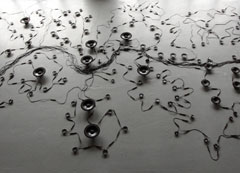
Soundcities was the first online open source database of city sounds and soundmaps from around the world, using found sounds and field recording. There are now thousands of sounds from around the world on the website. The concept started in 1995 with various iterations. In 1996 Stanza devised the term soundmaps and intitiated the varios works that developed into soundcities.comStanza's soundmaps have been online since 2000 and the Soundcities database since 2004. This project allows the audience the possibility to remix the hundreds of samples recorded from cities around the world in an online database. The sounds can be listened to, used in performances on laptops, or played on mobiles via wireless networks.The Database is also open so anyone can upload sounds they collect from world cities, thereby making a contribution to the project and making an online sounds archive.
The sounds of cities also give clues to the emotional and responsive way we interact with our cities. Cities all have specific identities, and found sound can give us clues to the people that inhabit these spaces, as well as provoking us and stimulating our senses in a musical way. I am interested in the sounds of specific places, and how the sounds reflect this identity and re-imposes characteristics back onto the location or environment. The aim is to create an online aural experience that evokes place, both as literal description but also developed musical composition. The sounds of cities evoke memories. As globalization fractures the identity of the city experience we start to find things that appear the same the world over.
A growing labyrinth, a community of aural cityscapes and collages is now evolving.The nature of the sounds and noise of cities varies in tone and language. A background rhythm can come into the foreground. It mixes itself, and evolves. The city is its own music, constantly evolving, a beautiful composition of squeaks, clanks, and pulses we compose this orchestra as we move about. We control the interface of the city as we navigate the streets. We are familiar but distracted as it bombards our conscious slipstream. The sounds evolve, generate, move, die, fade and shift. The sounds of the city are out there all the time, there is no silence. The children, the trains, the drills, the animals, the micro sounds, the sounds of our bodies, the sounds of the street, the insides of our souls. Familiar forms, identities and sounds are common to all cities, and yet each have special forms that separate and identity particular places and spaces.
The city is the orchestra. As globalization fractures the identity of the city experience we start to find things that appear the same the world over. Soundcities, involves field recording literally the sounds we hear as we walk out of the door. Not just as noise (data) or as noise pollution but also as an appreciation of sound and how this not only affects the space but is the space.The noise is the city, the noise is the music, the city is the orchestra and we are just conductors whose interactive actions compose this music as we walk around. We control the interface of the city as we navigate the streets. We are responsive in out interactions of the city space."
idea of south - resonances of location and memory
Glenn Gould radio documentary - The Idea of North
Glenn Gould | Dec 28, 1967 | 59:14
Gould’s first "contrapuntal radio documentary" and the first installment in his "Solitude Trilogy." Originally broadcast on the CBC Radio programme Ideas, Dec. 28, 1967. An anthropologist, sociologist, a nurse, and a surveyor discuss the subjective 'idea' and the reality of the North. Montage and voice counterpoint are used to express the antagonism and scope of the country, the loneliness and isolation, the warmth of community living, personal reasons for living there, the fear that human nature will gradually take over from the elements as common enemy number one, and the challenge involved in any decision to live there. During the last eight minutes the voices are heard over music.
Listen: http://www.cbc.ca/player/Radio/More+Shows/Glenn+Gould+-+The+CBC+Legacy/Audio/1960s/ID/2110447480/
Roger Mills' Idea of South
 Inspired by resonances of location and memory, Idea of South sets out to
explore, provoke and question our sense of place in the southern
hemisphere. Combining networked terrestrial radio and Internet
streaming, the work is composed as three individual audio tracks,
comprising live music, field recordings and spoken word. The three audio
streams are broadcast simultaneously and experienced by listeners
tuning their radios into both radio stations and a home computer or
iPhone for the Internet stream. As the program moves through hot dry
deserts or icy Antarctic waters, the sense of these locations is
enhanced through the diffusion of sound over a multi-channel broadcast,
taking radio out of the singular domain that it normally inhabits into
an immersive radiophonic experience. I also encourage listeners to
experiment with the position of their devices. Involving them in this
process further enhances their experience of the work.
Inspired by resonances of location and memory, Idea of South sets out to
explore, provoke and question our sense of place in the southern
hemisphere. Combining networked terrestrial radio and Internet
streaming, the work is composed as three individual audio tracks,
comprising live music, field recordings and spoken word. The three audio
streams are broadcast simultaneously and experienced by listeners
tuning their radios into both radio stations and a home computer or
iPhone for the Internet stream. As the program moves through hot dry
deserts or icy Antarctic waters, the sense of these locations is
enhanced through the diffusion of sound over a multi-channel broadcast,
taking radio out of the singular domain that it normally inhabits into
an immersive radiophonic experience. I also encourage listeners to
experiment with the position of their devices. Involving them in this
process further enhances their experience of the work.
Idea of South is a culmination of two separate projects. The first, Tohora, a fugue for trumpet and whale is inspired by a hydrophone recording of a Minky whale my father captured off Macquarie Island. I was intrigued by the similarities in timbre of the whale song to my own trumpet playing and composed a work of contrapuntal textures in response to the recording. This was performed as a live Internet stream at Placard Headphones festival in San Francisco in December 2008 and became the main melodic theme of Idea of South. Tohora (a fugue for trumpet and whale) is currently installed as part of Audio on Loop at Loop Space Gallery, Newcastle.
The second project was a collaboration with artist Neil Jenkins on an interactive web map installation. Part phonography and part psychogeography, the map is a sound journey around the southern hemisphere, which unfolds as participants move their cursors over chosen locations. These individual audio segments can then be mixed in separate player windows to form a sound collage of the cursors movement around the map. The location recordings are contributions from sound artists and phonographers throughout the southern hemisphere from an advertised call for submissions. I received recordings from locations as diverse as New Zealand and Uruguay, all accompanied by latitude and longitude coordinates and personal stories about the locations where they were recorded. The sound map is an ongoing project and continues to grow as more contributions are added, and selected recordings from the map form an integral part of the radiophonic work.
http://www.realtimearts.net/studio-artist/idea-of-south
soundmap: http://ideaofsouth.netpraxis.net/map/
Glenn Gould | Dec 28, 1967 | 59:14
Gould’s first "contrapuntal radio documentary" and the first installment in his "Solitude Trilogy." Originally broadcast on the CBC Radio programme Ideas, Dec. 28, 1967. An anthropologist, sociologist, a nurse, and a surveyor discuss the subjective 'idea' and the reality of the North. Montage and voice counterpoint are used to express the antagonism and scope of the country, the loneliness and isolation, the warmth of community living, personal reasons for living there, the fear that human nature will gradually take over from the elements as common enemy number one, and the challenge involved in any decision to live there. During the last eight minutes the voices are heard over music.
Listen: http://www.cbc.ca/player/Radio/More+Shows/Glenn+Gould+-+The+CBC+Legacy/Audio/1960s/ID/2110447480/
Roger Mills' Idea of South
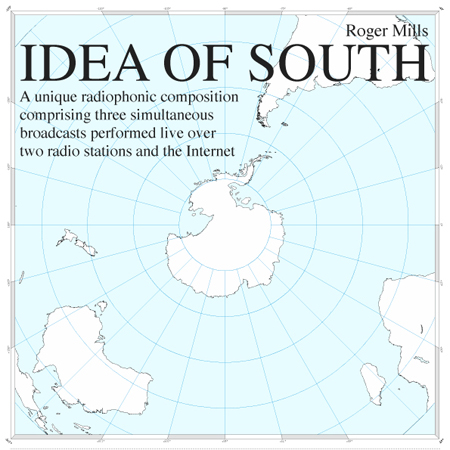
Idea of South is a culmination of two separate projects. The first, Tohora, a fugue for trumpet and whale is inspired by a hydrophone recording of a Minky whale my father captured off Macquarie Island. I was intrigued by the similarities in timbre of the whale song to my own trumpet playing and composed a work of contrapuntal textures in response to the recording. This was performed as a live Internet stream at Placard Headphones festival in San Francisco in December 2008 and became the main melodic theme of Idea of South. Tohora (a fugue for trumpet and whale) is currently installed as part of Audio on Loop at Loop Space Gallery, Newcastle.
The second project was a collaboration with artist Neil Jenkins on an interactive web map installation. Part phonography and part psychogeography, the map is a sound journey around the southern hemisphere, which unfolds as participants move their cursors over chosen locations. These individual audio segments can then be mixed in separate player windows to form a sound collage of the cursors movement around the map. The location recordings are contributions from sound artists and phonographers throughout the southern hemisphere from an advertised call for submissions. I received recordings from locations as diverse as New Zealand and Uruguay, all accompanied by latitude and longitude coordinates and personal stories about the locations where they were recorded. The sound map is an ongoing project and continues to grow as more contributions are added, and selected recordings from the map form an integral part of the radiophonic work.
http://www.realtimearts.net/studio-artist/idea-of-south
soundmap: http://ideaofsouth.netpraxis.net/map/
Sensing Shared Places
RUI CHAVES & PEDRO REBELO
"Sensing Shared Places: Designing a mobile audio streaming environment
This paper addresses mobile audio streaming in the context of sharing a sense of place. This action is mediated by the network, the body and remote listening. These elements are essential in the concept and design of a platform for audio transmission ( liveshout ), that aims at intersecting mobility within the realms of radio, network and transmission art. "
http://people.brunel.ac.uk/bst/vol1001/ruichaves/home.html
http://www.somasa.qub.ac.uk/~liveshout/
"Sensing Shared Places: Designing a mobile audio streaming environment
This paper addresses mobile audio streaming in the context of sharing a sense of place. This action is mediated by the network, the body and remote listening. These elements are essential in the concept and design of a platform for audio transmission ( liveshout ), that aims at intersecting mobility within the realms of radio, network and transmission art. "
http://people.brunel.ac.uk/bst/vol1001/ruichaves/home.html
http://www.somasa.qub.ac.uk/~liveshout/
Wien - Akustische Fundstücke
Das Orange 94.0 Projekt "Akustische Fundstücke" befasst sich mit der Stadt als Lebens- und Arbeitsraum.
In 30 minütigen Beiträgen werden verschiedenste Plätze in Wien besucht und gemeinsam mit den Menschen vor Ort Sendungen zu den interessanten, verborgenen, brisanten oder einfach typischen Grätzln in Wien produziert.
Mit den Mitteln des Radios soll ein akustisches Portrait von Wien entstehen, das vor allem die nicht so bekannten Seiten unserer Stadt hörbar macht. Der "Sound of Vienna", wie er wirklich klingt.
http://stadtradio.o94.at/
In 30 minütigen Beiträgen werden verschiedenste Plätze in Wien besucht und gemeinsam mit den Menschen vor Ort Sendungen zu den interessanten, verborgenen, brisanten oder einfach typischen Grätzln in Wien produziert.
Mit den Mitteln des Radios soll ein akustisches Portrait von Wien entstehen, das vor allem die nicht so bekannten Seiten unserer Stadt hörbar macht. Der "Sound of Vienna", wie er wirklich klingt.
http://stadtradio.o94.at/
Patrick Müller - Stadt – Klang – Normalität
Stadt – Klang – Normalität
Auseinandersetzungen mit Klangräumen des Urbanen
Murray Schafer:
http://www.arch.ksu.edu/seamon/Schafer06.htm
Klang als Symbol von Macht
Klang als Analysetool für Sozialstrukturen
HiFi vs LoFi
Barry Truax
Pierre Schaefer
Luc Ferrari
Pascal Amphoux, Anthropologie der Geräuschwelt
Auseinandersetzungen mit Klangräumen des Urbanen
Murray Schafer:
http://www.arch.ksu.edu/seamon/Schafer06.htm
Klang als Symbol von Macht
Klang als Analysetool für Sozialstrukturen
HiFi vs LoFi
Barry Truax
Pierre Schaefer
Luc Ferrari
Pascal Amphoux, Anthropologie der Geräuschwelt
Montag, 6. Januar 2014
TING / TIPTOI


http://de.wikipedia.org/wiki/Tiptoi
http://www.ravensburger.de/kinder/tiptoi/index.html
http://www.ting.eu/
Music Map - Landkarte der Musik (Floating Tagcloud Darstellung)
"Gnod is a self-adapting system that learns about the outer world by asking its visitors what they like and what they don't like. In this instance of gnod all is about music. Gnod is kind of a search engine for music you don't know about. It will ask you what music you like and then think about what you might like too. When I set gnod online its database was completely empty. Now it contains thousands of bands and quite some knowledge about who likes what. And gnod learns more every day."
http://www.music-map.de/
"Gnod is a self-adapting system that learns about the outer world by asking its visitors what they like and what they don't like. In this instance of gnod all is about music. Gnod is kind of a search engine for music you don't know about. It will ask you what music you like and then think about what you might like too. When I set gnod online its database was completely empty. Now it contains thousands of bands and quite some knowledge about who likes what. And gnod learns more every day."
http://www.music-map.de/
How to Make a Sound Map: Cartographic, Compositional, Performative
Maps are ultimately representations, which suggest no boundaries as to how it is represented indeed representation is chosen by those representing. They should accepted as a subjective truth insofar that the map is an abstraction derived from something- the geographical territory- but it is not the thing itself.
What I am trying to say is that like any map, sound maps should have no prescribed method. However you choose to represent, do what you want. But here are a couple of methods. (If you’re interested in the philosophy, check out ‘Map-territory relation’ on Wikipedia and the links on there. Bateson, Baudrillard, Korzybski, eat your heart out.)"
http://acousticecologyuoh.wordpress.com/2013/12/04/how-to-make-a-sound-map/
Mapping Out the Sound Memory of Beirut

A survey of the music of a war generation
Thomas Burkhalter
"Various social and cultural scientists1 propagate that research on cultural globalisation and localisation should focus on individuals and their thoughts and ideas, since the latter reflect theoretical concepts such as “identity”, “transnationality” and “hybridity”. My Ph.D. project “Significant Sounds – Beiruti Music between new artistic forms and local, global dependencies” focuses on music, as human ideas and visions are not expressed in words only. Musicians choose local and global forms and styles, sounds and beats to create meaning and to express their connection to different cultural, social and ideological settings. At the same time, music, as individualistic and revolutionary as it might be, is always produced, distributed and discussed within different -scapes (Appadurai 2003) of the outside world. It is produced and distributed in highly contesting finance-scapes between multinational companies, that aim to control global and local cultural markets, and independent networks, that benefit from new possibilities in music production and distribution given by multimedia and communication industries (techno-scapes). Global and local media-scapes influence music production by creating cultural tastes and standards2 and subsequently by constantly reproducing those standards with their choices. Steering happens as well through values and ideologies promoted by local and global governmental and non-governmental institutions and organisations (ideo-scapes) through funding decisions and sometimes censorship. Last but not least, in a country like Lebanon local and global ethno-scapes have an impact on musical creativity: the global world music market and the international funding bodies tend to favour local and transnational music that deals with its Arabic cultural heritage. Many authors have pointed out the concept of difference3 in their writings on cultural dialogue between the “East” and the “West”. Eng (in Shepherd and Wicke 1997: 98) even considers that “the racist love of a foreign country” [the love of difference] is strongly “linked to women and to music.” Inside Lebanon the different cultural representations of the various religious communities – from the popular, synthesised dabkeh songs praising Hezbollah or Amal leaders to the hymns for the Christian Lebanese Forces and Kataeb militias – were always a challenging factor for the national identity in this multi-confessional state. The Lebanese minister for culture, Dr. Tarek Mitri, stated in a conference on “Cultural Diversity”4 that Lebanon, on the one hand, is proud of its cultural diversity, however, on the other side this cultural diversity is a challenge for the national identity. He concluded by saying that the Ministry of Culture aims to build bridges between different artistic expressions. Does this mean that the Lebanese state and its institutions tend to favour artistic forms that melt the cultural diversities of Lebanon into one piece of art, over artistic expressions that focus on extreme positions?5 The creation of a “Lebanese music”, as I shall argue later, seems to underline this assumption. [...]"
http://books.openedition.org/ifpo/550
Photo: Sharif and Christine Sehnaoui, Fabrizio Spera and Mazen Kerbaj (from left to right) at the Irtijal-Festival 2006. By Thomas Burkhalter (www.norient.com)
Bibliography on Noise Pollution

http://discardstudies.wordpress.com/2013/10/21/bibliography-on-noise-pollution/
online sound maps overview
online sound maps overview
http://www.stadtmusik.org/sonic-urbanism/sound-maps-overview
the auditory image of the city
The sonic signature has a strong contribution to the identity of the place. Examples and observations of auditory phenomena that shape the perception of urban places. Visual references make the relationship between physical configuration and sound, but also the interplay between the visual and hearing sense apparent.
http://www.stadtmusik.org/sonic-urbanism/the-auditory-image-of-the-city
http://www.stadtmusik.org/sonic-urbanism/sound-maps-overview
the auditory image of the city
The sonic signature has a strong contribution to the identity of the place. Examples and observations of auditory phenomena that shape the perception of urban places. Visual references make the relationship between physical configuration and sound, but also the interplay between the visual and hearing sense apparent.
http://www.stadtmusik.org/sonic-urbanism/the-auditory-image-of-the-city
Mapping The Soundscape

by
Abstract:
"With the recent availability of open source application programming interfaces for digital mapping, programmers have been able create applications that literally put music and sound on the map. Since the mid-2000s, sound artists, electroacoustic composers and archivists have been able to use digital resources to map their field recordings, most popular of which has been Google Maps. Many of these maps allow for users to upload their own recordings, creating maps with thousands of sound clips. This presentation aims to explore the possibility of musicological scholarship concerning practices of digital mapping of music and sound on computers, tablets and smartphones.
This presentation will provide a history of sound mapping as used by sound recordists and composers. Beginning with Tony Schwartz’ sound documentary form which examples of this New York 19 and The World in My Mailbox, I will explain how these recordings establish a sense of place. Schwartz’ recordings influenced the members of the World Soundscape Project to develop their own sound maps for their series The Music of The Environment. I will also review the uses of the twenty-two largest participant-interactive online sound maps, including the Toronto Sound Map, The London Sound Survey, The Göteborg Sound Map, and the Tactical Sound Gardens. Additionally, I will discuss my own use of sound maps as a musicological teaching resource, working on projects with Smithsonian Folkways Recordings, MIT Media Lab professor Tod Machover, and for the University of Alberta/Cape Breton University project “Celebrating East European communities and cultures in Cape Breton, Nova Scotia”. All of these examples of contribute to the use of digital sound mapping as an ethnographic research tool and a teaching resource."
http://www.academia.edu/4025846/Mapping_The_Soundscape_Electro-acoustic_Composition_and_Place-making_in_Interactive_Sound_Maps
Music in The Medium: An Ecomusicological Analysis of Field Recordings
http://artefactpublication.com
Soundwalk Collective - Medea

Medea is an original composition based on recordings of radio waves as well as voice and sound fragments collected by Soundwalk Collective during a two-month crossing in a sailing boat specially equipped with scanners, microphones and high-range aerials.
Medea reaches into Turkey, Georgia, Russia, Crimea, Ukraine, Romania and Bulgaria and embarks on a sound reading of a region of the world whose quivering beauty remains cruel and obscure – akin to the ancient Medea.
http://soundwalkcollective.com/index.php?/progress/black-sea/
The Noisy Reef

"The noisy reef takes us under the waves to the reefs of New Zealand to explore sound and noise under water. Using this unique habitat, we look at what sound is, how it travels, what changes under water and how animals use sound in their world."
http://www.sciencelearn.org.nz/Contexts/The-Noisy-Reef/NZ-Research/The-Noisy-Reef
Samstag, 14. Dezember 2013
Sonification / Soundmapping
Locating the transmission & Transmitting the location (Moderator
David Cecchetto) with Geoffrey Shea / Victoria Fenner / Kristen Roos
"A sonic portrait of a place, a site specific transmission art performance and locative media apps for mobile phones are each points of reference in this panel discussion. How does location inform artistic content? How does the way in which an artwork is transmitted determine the experience?"
http://naisa.ca/wp-content/audio/RWB12/Transx2012_SheaFennerRoos_Panel.mp3
http://naisa.ca/media-archive/audio-archives/
Soundscape, sonification, and sound activism
"In this article, the author will argue that the act of listening through public soundwalks and other formal and informal exercises builds environmental and social awareness and promotes changes in social and cultural practices. By examining the act of listening as an alternative pathway and comparing the research, writings, and creative work of leaders of the acoustic ecology movement (i.e., R. Murray Schafer, Hildegard Westerkamp, and Bernie Krause), the author hopes to shed light on these potentials."
Andrea Polli, http://link.springer.com/article/10.1007/s00146-011-0345-3
Wayfinding without Visual Cues: Evaluation of an Interactive Audio Map System
"We present the evaluation of an interactive audio map system that enables blind and partially sighted users to explore and navigate city maps from the safety of their home using simulated 3D audio and synthetic speech alone. We begin with a review of existing literature in the areas of spatial knowledge and wayfinding, auditory displays and auditory map systems, before describing how this research builds on and differentiates itself from this body of work. One key requirement was the ability to quantify the effectiveness of the audio map, so we describe the design and implementation of the evaluation, which took the form of a game downloaded by participants to their own computers. The results demonstrate that participants (blind, partially sighted and sighted) have acquired detailed spatial knowledge and also that the availability of positional audio cues significantly improves wayfinding performance." http://iwc.oxfordjournals.org/content/early/2013/08/20/iwc.iwt042.short
Sublime Frequencies: The Construction of Sublime Listening Experiences in the Sonification of Scientific Data
"In the past two decades, the sonification of scientific data – an auditory equivalent of data visualization in which data are turned into sounds – has become increasingly widespread, particularly as an artistic practice and as a means of popularizing science. Sonification is thus part of the recent trend, discussed in public understanding of science literature, towards increased emphasis on ‘interactivity’ and ‘crossovers’ between science and art as a response to the perceived crisis in the relationship between the sciences and their publics. However, sonification can also be understood as the latest iteration in a long tradition of theorizing the relations between nature, science and human experience. This article analyses the recent public fascination with sonification and argues that sonification grips public imaginations through the promise of sublime experiences. I show how the ‘auditory sublime’ is constructed through varying combinations of technological, musical and rhetorical strategies. Rather than maintain a singular conception of the auditory sublime, practitioners draw on many scientific and artistic repertoires. However, sound is often situated as an immersive and emotional medium in contrast to the supposedly more detached sense of vision. The public sonification discourse leaves intact this dichotomy, reinforcing the idea that sound has no place in specialist science."
http://sss.sagepub.com/content/early/2013/12/11/0306312713496875.full.pdf+html
Verortung Sound Studies:
Sound Studies sind nicht Klangwissenschaft
"Im Falle der Sound Studies ist dies besonders auffällig, da sowohl die ersten ehemals prononcierten Arbeiten als auch die gegenwärtig avanciertesten Entwicklungen stets aus einer personellen, institutionellen und methodischen Verbindung von Kunst und Wissenschaft
hervorgegangen sind. Wenn ich den Schnitt des Beginns dieser Disziplin mit den historische Avantgarden des 20. Jahrhunderts und den Studien von Walter Ruttmann, Pierre Schaeffer, mit John Cage und Alvin Lucier ansetze oder mit den Arbeiten von Raymond Murray Schafer oder Barry Truax: in all diesen Fällen verflochten sich künstlerisch-gestalterische Empirie mit wissenschaftlich-konzeptuellem Begriff der Klänge – selbst in der Forschung des Physiologen und Pianisten Hermann von Helmholtz im 19. Jahrhundert. Vor allem die Untersuchungen von Schafer und Truax haben bis heute ihren Wert in den Sound Studies erhalten; ihre Schriften werden weiterhin als Grundlagen- und Einführungswerke genutzt und ihre Studien werden unmittelbar weiterentwickelt, da sie den Stadtraum, die Landschaft auf eine andere und neue Weise durchhorchten: sie betonten die Sinnesvielfalt und Körperempfindung, zeichneten sie auf und führten gestaltend die Hörlandschaft der Welt ihren Zeitgenossen und uns vor Ohren. Den künstlichen Schnitt des Anfangs möchte ich darum bei diesen Forschungen ansetzen." http://www.soundstudieslab.org/wp-content/uploads/2012/04/Holger_Schulze_-_Sound_Studies_stw_Stephan_Moebius_Neue_Kulturforschungen_2011_.pdf
Geräuschlandschaft der heutigen Grossstadt
http://voices-of-wedding.tonspur.at/wp-content/uploads/2010/11/Abating-the-noise-evil_.pdf
----------------------------------------------------------------------------------------------------------
Kunsttexte.de »Aktuelle Ausgabe
» Auditive Perspektiven (2/2013)
SOUNDMAPPING
----------------------------------------------------------------------------------------------------------
http://www.armedforces-int.com/video/sound-mapping-technology.html
Journal of Sonic Studies, volume 1, nr. 1 (October 2011)
SOUNDMAPPING: Critiques And Reflections On This New Publicly Engaging Medium
Jacqueline Waldock
"Soundmaps have captured the imagination of acoustic communities, libraries and radio stations alike. These interactive maps have placed soundscape collections and research in a more public and interactive space than ever before. However, does this new form reflect some of the polarizations of past sound projects or are there new fractures to be considered, such as gender, economy and the domestic/public divide? This paper will reflect upon the challenges and hierarchies that have developed alongside this new medium and will begin to critique and question this new form of sound engagement."
http://journal.sonicstudies.org/vol01/nr01/a08
The Aesthetics of Music and Sound
Cross-Disciplinary Interplay between the Humanities, Technology and Musical Practice
http://www.soundmusicresearch.org/
Christa Brüstle, Akustische Landaufnahme und Klangkartographie
http://edoc.hu-berlin.de/kunsttexte/2013-2/bruestle-christa-1/PDF/bruestle.pdf
Hildegard Westerkamp, Listening and soundmaking : a study of music-as-environment
http://summit.sfu.ca/system/files/iritems1/5386/b15022705.pdf
ATLAS MAPPING, Künstler als Kartographen. Kartographie als Kultur
http://www.kunsthaus-bregenz.at/html/aus_atlasmap.htm
What can 3-D sound mapping do for you?http://www.edn.com/electronics-blogs/test-times/4421805/What-can-3-D-sound-mapping-do-for-you-
"A sonic portrait of a place, a site specific transmission art performance and locative media apps for mobile phones are each points of reference in this panel discussion. How does location inform artistic content? How does the way in which an artwork is transmitted determine the experience?"
http://naisa.ca/wp-content/audio/RWB12/Transx2012_SheaFennerRoos_Panel.mp3
http://naisa.ca/media-archive/audio-archives/
Soundscape, sonification, and sound activism
"In this article, the author will argue that the act of listening through public soundwalks and other formal and informal exercises builds environmental and social awareness and promotes changes in social and cultural practices. By examining the act of listening as an alternative pathway and comparing the research, writings, and creative work of leaders of the acoustic ecology movement (i.e., R. Murray Schafer, Hildegard Westerkamp, and Bernie Krause), the author hopes to shed light on these potentials."
Andrea Polli, http://link.springer.com/article/10.1007/s00146-011-0345-3
Wayfinding without Visual Cues: Evaluation of an Interactive Audio Map System
"We present the evaluation of an interactive audio map system that enables blind and partially sighted users to explore and navigate city maps from the safety of their home using simulated 3D audio and synthetic speech alone. We begin with a review of existing literature in the areas of spatial knowledge and wayfinding, auditory displays and auditory map systems, before describing how this research builds on and differentiates itself from this body of work. One key requirement was the ability to quantify the effectiveness of the audio map, so we describe the design and implementation of the evaluation, which took the form of a game downloaded by participants to their own computers. The results demonstrate that participants (blind, partially sighted and sighted) have acquired detailed spatial knowledge and also that the availability of positional audio cues significantly improves wayfinding performance." http://iwc.oxfordjournals.org/content/early/2013/08/20/iwc.iwt042.short
Sublime Frequencies: The Construction of Sublime Listening Experiences in the Sonification of Scientific Data
"In the past two decades, the sonification of scientific data – an auditory equivalent of data visualization in which data are turned into sounds – has become increasingly widespread, particularly as an artistic practice and as a means of popularizing science. Sonification is thus part of the recent trend, discussed in public understanding of science literature, towards increased emphasis on ‘interactivity’ and ‘crossovers’ between science and art as a response to the perceived crisis in the relationship between the sciences and their publics. However, sonification can also be understood as the latest iteration in a long tradition of theorizing the relations between nature, science and human experience. This article analyses the recent public fascination with sonification and argues that sonification grips public imaginations through the promise of sublime experiences. I show how the ‘auditory sublime’ is constructed through varying combinations of technological, musical and rhetorical strategies. Rather than maintain a singular conception of the auditory sublime, practitioners draw on many scientific and artistic repertoires. However, sound is often situated as an immersive and emotional medium in contrast to the supposedly more detached sense of vision. The public sonification discourse leaves intact this dichotomy, reinforcing the idea that sound has no place in specialist science."
http://sss.sagepub.com/content/early/2013/12/11/0306312713496875.full.pdf+html
Verortung Sound Studies:
Sound Studies sind nicht Klangwissenschaft
"Im Falle der Sound Studies ist dies besonders auffällig, da sowohl die ersten ehemals prononcierten Arbeiten als auch die gegenwärtig avanciertesten Entwicklungen stets aus einer personellen, institutionellen und methodischen Verbindung von Kunst und Wissenschaft
hervorgegangen sind. Wenn ich den Schnitt des Beginns dieser Disziplin mit den historische Avantgarden des 20. Jahrhunderts und den Studien von Walter Ruttmann, Pierre Schaeffer, mit John Cage und Alvin Lucier ansetze oder mit den Arbeiten von Raymond Murray Schafer oder Barry Truax: in all diesen Fällen verflochten sich künstlerisch-gestalterische Empirie mit wissenschaftlich-konzeptuellem Begriff der Klänge – selbst in der Forschung des Physiologen und Pianisten Hermann von Helmholtz im 19. Jahrhundert. Vor allem die Untersuchungen von Schafer und Truax haben bis heute ihren Wert in den Sound Studies erhalten; ihre Schriften werden weiterhin als Grundlagen- und Einführungswerke genutzt und ihre Studien werden unmittelbar weiterentwickelt, da sie den Stadtraum, die Landschaft auf eine andere und neue Weise durchhorchten: sie betonten die Sinnesvielfalt und Körperempfindung, zeichneten sie auf und führten gestaltend die Hörlandschaft der Welt ihren Zeitgenossen und uns vor Ohren. Den künstlichen Schnitt des Anfangs möchte ich darum bei diesen Forschungen ansetzen." http://www.soundstudieslab.org/wp-content/uploads/2012/04/Holger_Schulze_-_Sound_Studies_stw_Stephan_Moebius_Neue_Kulturforschungen_2011_.pdf
Zur Geschichte des Hörens, Daniel Morat
http://www.zeithistorische-forschungen.de/Portals/_zf/documents/pdf/2011-2/Morat_2011.pdfGeräuschlandschaft der heutigen Grossstadt
http://voices-of-wedding.tonspur.at/wp-content/uploads/2010/11/Abating-the-noise-evil_.pdf
----------------------------------------------------------------------------------------------------------
Kunsttexte.de »
SOUNDMAPPING
| Brüstle, Christa: Akustische Landaufnahme und Klangkartographie | |||
| Kletschke, Irene: Karte und Landschaftskomposition | |||
| Döbereiner, Luc: Kartographie des kompositorischen Raums | |||
| Thoben, Wilm: Das Spiel mit der Erde | |||
| Avanzini, Susanna: Choreografie, Kartographie oder Malerei? | |||
| Stingel-Voigt, Yvonne: "The Path" | |||
| Gerwin, Thomas: "KlangWeltKarte" (1997) | |||
| Blondeel, Maria: An Artistic Sonic Mobile Mapping System | |||
| Engelen, William: Vorspeise | |||
| Aisch, Gregor; Matzat, Lorenz: Fluglärmkarte BER | |||
| Tosques, Fabio; Castellarin, Michele: Das Vivaio Acustico delle Lingue e dei Dialetti d’Italia (VIVALDI) | |||
| Matthias, Annette: Form follows sense | |||
| Auinger, Sam: Hoer-Orte Bonn | |||
| Schröder, Julia: Inhaltsverzeichnis |
http://www.armedforces-int.com/video/sound-mapping-technology.html
Journal of Sonic Studies, volume 1, nr. 1 (October 2011)
SOUNDMAPPING: Critiques And Reflections On This New Publicly Engaging Medium
Jacqueline Waldock
"Soundmaps have captured the imagination of acoustic communities, libraries and radio stations alike. These interactive maps have placed soundscape collections and research in a more public and interactive space than ever before. However, does this new form reflect some of the polarizations of past sound projects or are there new fractures to be considered, such as gender, economy and the domestic/public divide? This paper will reflect upon the challenges and hierarchies that have developed alongside this new medium and will begin to critique and question this new form of sound engagement."
http://journal.sonicstudies.org/vol01/nr01/a08
The Aesthetics of Music and Sound
Cross-Disciplinary Interplay between the Humanities, Technology and Musical Practice
http://www.soundmusicresearch.org/
Christa Brüstle, Akustische Landaufnahme und Klangkartographie
http://edoc.hu-berlin.de/kunsttexte/2013-2/bruestle-christa-1/PDF/bruestle.pdf
Hildegard Westerkamp, Listening and soundmaking : a study of music-as-environment
http://summit.sfu.ca/system/files/iritems1/5386/b15022705.pdf
ATLAS MAPPING, Künstler als Kartographen. Kartographie als Kultur
http://www.kunsthaus-bregenz.at/html/aus_atlasmap.htm
What can 3-D sound mapping do for you?http://www.edn.com/electronics-blogs/test-times/4421805/What-can-3-D-sound-mapping-do-for-you-
Soundmapping
The Sight of Sound: Mapping Audio
There is something about mapping that seems almost antithetical to sound. The idea of mapping stems from our desire to know where we are going. In order to orient ourselves, we need to create grids and boundaries. But boundaries don't apply to sound. Unlike maps, sound does not rely on surfaces or depths; rather, it penetrates them. Sound waves literally impinge upon bodies; they break through the boundaries of organic and inorganic bodies in the form of vibrations. Sound is experienced as simultaneously interior and exterior, but mapping (in the case of place) only deals with exteriority. It helps us to make sense of territories, to objectify and dissect landscapes so that they are easier to interpret and navigate.
http://www.hastac.org/blogs/stephceraso/sight-sound-mapping-audio
Firenze Sound Map
http://www.firenzesoundmap.org/news.asp?id=61
Mapping Sojourners' Soundscapes: Listening Experiences of Taipei Sojourners in London (2010)
http://www.arttwchen.com/home/phd-thesis
There is something about mapping that seems almost antithetical to sound. The idea of mapping stems from our desire to know where we are going. In order to orient ourselves, we need to create grids and boundaries. But boundaries don't apply to sound. Unlike maps, sound does not rely on surfaces or depths; rather, it penetrates them. Sound waves literally impinge upon bodies; they break through the boundaries of organic and inorganic bodies in the form of vibrations. Sound is experienced as simultaneously interior and exterior, but mapping (in the case of place) only deals with exteriority. It helps us to make sense of territories, to objectify and dissect landscapes so that they are easier to interpret and navigate.
http://www.hastac.org/blogs/stephceraso/sight-sound-mapping-audio
Firenze Sound Map
http://www.firenzesoundmap.org/news.asp?id=61
Mapping Sojourners' Soundscapes: Listening Experiences of Taipei Sojourners in London (2010)
http://www.arttwchen.com/home/phd-thesis
Abonnieren
Posts (Atom)